




Yesterday, 08:52
(This post was last modified: Yesterday, 09:54 by MDuperrier.
Edit Reason: Typo #2
)
Hello,
It would absolutely help to deploy a new detector in an highly active region and far from other detectors. It will most likely not provide much better detection in the close range due to all great explanation provided above by true expert.
But, I have learned, trying improve detection and localization of strikes in Africa that another very important factor is MCG.
MCG = maximal circular gap in degree (for example, 210 degree = the detectors are in a sector of 150 degree from the point of view of the impact position)
I do not read much on this forum about this hard limit of 270° but it certainly limit (on purpose, for quality) the detection in many part of the world.
Since the MCG is 270° it means that all participating detectors must be contain in a 90° angle (or more) from the strike point to be validated and displayed. From school, this limit is defined as a semi-circle between 2 points.
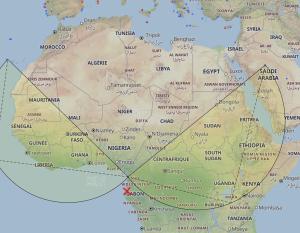
In the example above, I put a red cross in a nearly blind spot. The left semi-circle is the lower limit of what strikes can be computed between the Canary Island and my detector in Cameroon. The right part is between Saudi Arabia and my detector.
There are hundreds of detectors in Europe that can records a strong strike near the red cross but it will never be validated as all detectors are located in less than 90° (the gap is more than 270°).
There are some detection below that limit, but it requires contribution from La Réunion, Brazil, or South Africa, all of them very far.
I run a little script that query for all computed strikes between 20° west & 50° east, below the tropic of Cancer (my, WIDE, area of interest) and I'm pretty familiar with the detectors involved in this area.
Your contribution will help improving detection in South America, south Atlantic and west Africa because it will provide a better angle.
Thanks and regards,
Marc
P.S. I'm still looking for a host in eastern Africa for the same reason.
It would absolutely help to deploy a new detector in an highly active region and far from other detectors. It will most likely not provide much better detection in the close range due to all great explanation provided above by true expert.
But, I have learned, trying improve detection and localization of strikes in Africa that another very important factor is MCG.
MCG = maximal circular gap in degree (for example, 210 degree = the detectors are in a sector of 150 degree from the point of view of the impact position)
I do not read much on this forum about this hard limit of 270° but it certainly limit (on purpose, for quality) the detection in many part of the world.
Since the MCG is 270° it means that all participating detectors must be contain in a 90° angle (or more) from the strike point to be validated and displayed. From school, this limit is defined as a semi-circle between 2 points.
In the example above, I put a red cross in a nearly blind spot. The left semi-circle is the lower limit of what strikes can be computed between the Canary Island and my detector in Cameroon. The right part is between Saudi Arabia and my detector.
There are hundreds of detectors in Europe that can records a strong strike near the red cross but it will never be validated as all detectors are located in less than 90° (the gap is more than 270°).
There are some detection below that limit, but it requires contribution from La Réunion, Brazil, or South Africa, all of them very far.
I run a little script that query for all computed strikes between 20° west & 50° east, below the tropic of Cancer (my, WIDE, area of interest) and I'm pretty familiar with the detectors involved in this area.
Your contribution will help improving detection in South America, south Atlantic and west Africa because it will provide a better angle.
Thanks and regards,
Marc
P.S. I'm still looking for a host in eastern Africa for the same reason.